
How Reno People Searches Work
Start with the type of fact already in hand. An old street address points first to Washoe County property data and the regional map. A full name can be tested against recorded-document parties, court captions, Nevada business roles, or a professional board. A document number leads back to the Recorder for a plain or certified copy. Those paths are distinct. A miss in one index does not mean the person has no Reno record elsewhere.
The most useful search order moves from a broad identifier to the office’s own record. It also avoids treating an assessed owner as a resident or a business filing address as a current home. For family history, a Reno directory or newspaper may identify an address and relationship before any formal record is requested.
- Search the Washoe County Assessor by owner, address, or APN when real property may connect the person to Reno.
- Carry the owner name, APN, legal description, or last-document date into the Recorder’s grantor and grantee index.
- Choose Municipal, Justice, District, appellate, or federal court based on the kind and level of case.
- Use official voter, custody, business, or license systems only for the narrow facts each one publishes.
- Move to written requests, clerk service, the library, or archives when a useful record is not online.
Note: Keep names, dates, parcel numbers, and document numbers as the search moves between Reno custodians; they prevent false matches.
Reno Records Offices by Role
Reno records do not sit in one master database. The Recorder indexes deeds, liens, maps, mining documents, marriages, and UCC-related filings. The Assessor ties owner names to parcels for tax assessment. The County Clerk handles marriage licensing, fictitious firm names, notary bonds, and minister certificates. City departments retain their own municipal files, while each court clerk controls its cases. Access rules, fees, and copy types depend on that division.
The three offices below form a practical first tier. Recorder searches work best with a name or document reference. Assessor searches work with an owner, situs address, or APN. A Reno city request should identify the department, subject, names, address or incident number, and a useful date range. Detailed request law and copy procedures belong with the full Reno public records system.
Washoe County Recorder
Recorded deeds, liens, maps, mining and marriage documents
775-328-3660
Washoe County Assessor
Owner, address, APN and assessment records
775-328-2277
Reno City Records
Department files, permits, code and other municipal records
Online or written records request
City records request channel
Finding Reno Owners by Address
The Washoe County Assessor is the strongest address-to-name bridge in a Reno people search. Its portal accepts an APN, an address or situs, or an owner name. Situs means the physical location of a parcel. It may differ from the mailing address used for tax notices. An owner shown for assessment is not proof that the person lives there, but it gives a name and parcel identifier that can open the next official search.
Search results expose the APN, situs, assessed owner, last-document date, parcel status, a WRMS link, and a parcel-map link. The percent sign works as a wildcard in a term such as J%Doe, which helps with initials or name variants. Parcel data is maintained for assessment purposes and may not fully describe improvements. Building data should be checked with building or planning staff, and zoning with the planning agency.
| Portal field | How it helps a Reno search | Use with care |
|---|---|---|
| Search By | Select APN, address/situs, or owner | A selection and search term are required |
| APN | Identifies the assessed parcel | It is not a street address |
| Situs | Shows the physical parcel location | It can differ from the mailing address |
| Owner | Names the assessed owner | Ownership does not prove residence |
| Last Doc Date | Points toward a recent recorded filing | Use the Recorder to inspect the instrument |
| Links | Opens WRMS and the parcel map | Confirm corporate area and legal description |
Note: Washoe assessment rolls are also published as downloadable files, while the parcel portal is better for one focused Reno lookup.
Turning Reno Parcels Into Deeds
An APN does not replace a deed search. It gives the parcel identity needed to find recorded names with less guesswork. Take the assessed owner, legal description, and last-document date from the Assessor or parcel map. Then search the Recorder by party name and follow document references backward. Grantor means the person or entity transferring an interest. Grantee means the one receiving it.
Address text is not consistent across recorded instruments, which is why the parcel-first route matters. A current owner may lead to the most recent deed, and its legal description or prior grantor can reveal an earlier link. The Recorder says a paid-off mortgage normally produces a reconveyance or satisfaction. It does not create a new ownership deed. Once a document number is known, a plain or certified copy can be ordered. Available channels include the web entry, counter service, a request form, mail, email, fax, and phone guidance.
- APN
- The assessor’s administrative parcel number, used to keep one parcel distinct from another.
- Legal description
- The recorded land identity, which may use a subdivision, lot and block, parcel map, or metes and bounds.
- Reconveyance
- A recorded release showing that a deed of trust has been satisfied.
- Document number
- The Recorder’s filing identifier, useful when ordering or confirming a copy.
Reno Geography Chooses the Search
A Reno postal label does not prove that a parcel lies inside the city. Truckee Meadows includes Reno, Sparks, and broad unincorporated parts of Washoe County. That boundary decides which municipal office controls permit, code, and related address-led records. This is a key geographic limit for a Reno people search because the wrong city desk may have no custody even when the mailing address says Reno.
Use the Washoe Regional Mapping System with an address or APN. Select the parcel and read its Corporate Area. The county's parcel-jurisdiction instructions identify relevant layers such as the City of Reno Boundary, Sphere of Influence, zoning, and service information. Parcel-map and legal-description links then connect the street location to recorded maps and deeds. Regional address changes can also place the same property under old and new street labels across public systems, so historical work should test both.
Geography in practice: address or APN → WRMS Corporate Area → correct city or county custodian → permit, code, map, or request record.
Choosing a Reno Court Search
Reno has several court paths. Reno Municipal Court handles qualifying city misdemeanor and code matters. Reno Justice Court handles limited-jurisdiction cases. The Second Judicial District Court keeps general-jurisdiction civil and criminal files, along with family and probate matters. Nevada appellate courts maintain a separate electronic search, while federal cases in Reno use PACER through the U.S. District Court for Nevada. A name must go to the court level that could have heard the matter.
The Second Judicial District Court access page shows the local entry point captured below.
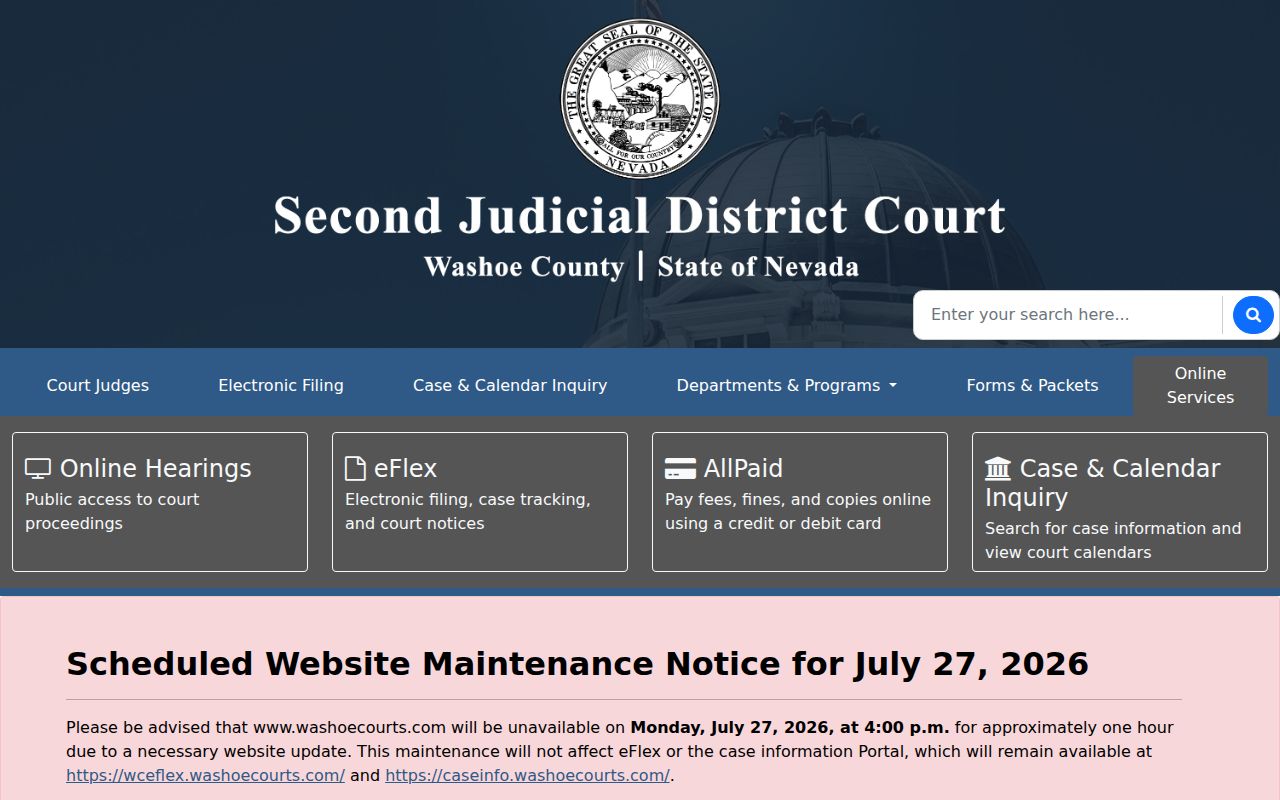
The court source helps route a Reno record search, but certified copies and records outside the web view still come from the clerk.
| Reno court level | Typical scope | Record channel | Main limit |
|---|---|---|---|
| Municipal Court | City misdemeanor and code matters | Municipal court service | Not the district or justice file |
| Justice Court | Limited-jurisdiction matters | Reno Justice Court channel | Scope differs from District Court |
| District Court | Civil, criminal, family, probate | Local portal and clerk | Some files are restricted |
| Nevada appellate | Appeals | State party or case search | Not every trial exhibit appears |
| Federal District | Federal cases | PACER | Published federal fees may apply |
Sealed, juvenile, and adoption material does not become public merely because a name is known. Clerk service remains the fallback for local files, certified copies, and records that are not available through a public screen.
Reno Appellate Search Fields
The Nevada appellate search can be useful after a Reno case reaches the Supreme Court or Court of Appeals. Search by a five-digit case number or by party or case name. First and middle name fields can narrow a participant search. Results arrange docket entries in filing order, with the newest at the bottom. A highlighted document number opens a PDF when that filing is public.
The official Nevada appellate case search instructions show the case-number and party-caption fields in the captured interface.
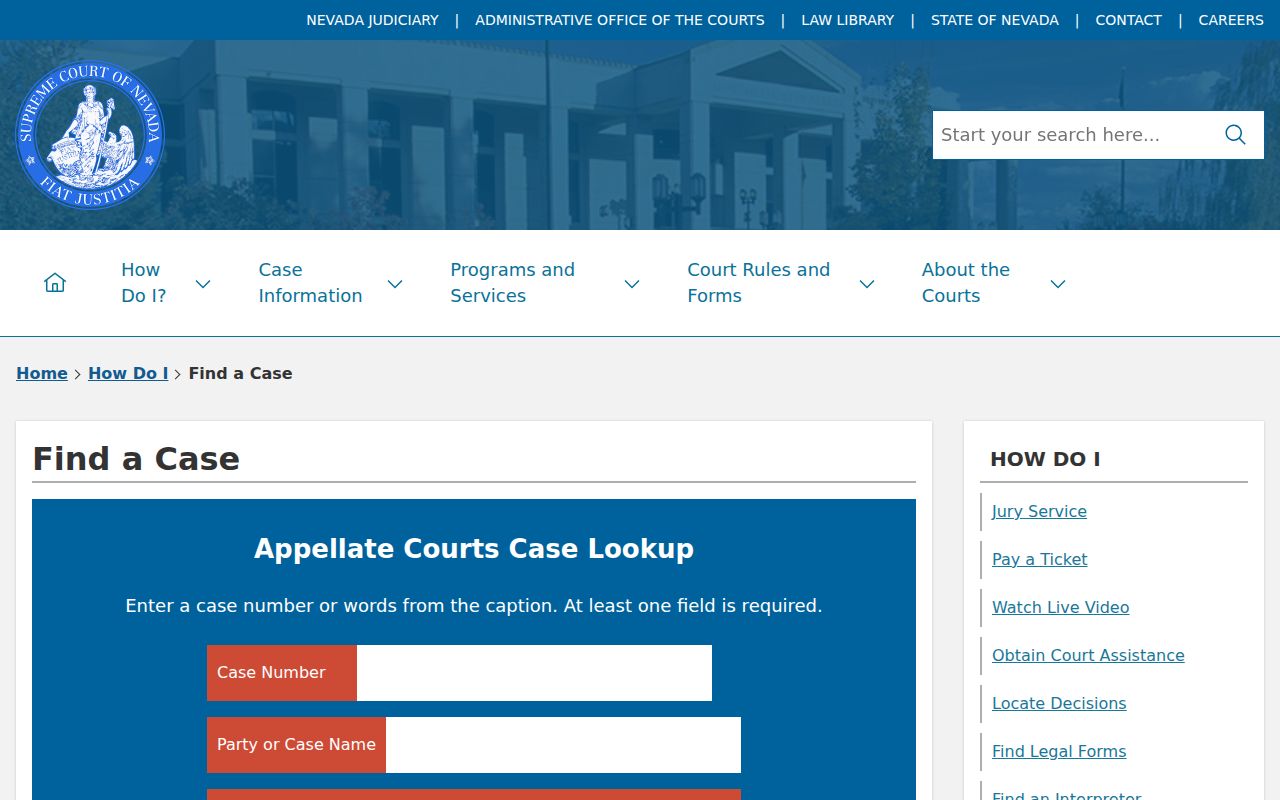
A result can show the caption, participant names, case number, filing dates, sequential docket entries, and linked public documents. It does not guarantee that each trial exhibit or sealed item is present.
Note: Search a Reno party with a case number when possible; common names alone can return unrelated appellate records.
Reno Vital Records Access
Birth and death certificates follow Nevada vital-statistics law, not ordinary open-record rules. The Nevada Office of Vital Records is the legal custodian for Nevada births and deaths from July 1, 1911. Local authorized service is available for Washoe events. Certificates are confidential and limited to qualified applicants, generally the registrant, direct family by blood or marriage, a guardian, or a legal representative. The state does not publish a simple rule that opens certificates after a set number of years.
The Nevada vital-record forms require record identity, event details, the applicant’s relationship or authority, contact and mailing information, identification, and payment. Certified birth copies cost $25, and Washoe-origin death copies cost $25. Pre-1911 research usually shifts to the county recorder, church registers, cemeteries, and newspapers.
Marriage licenses are county records, while divorce decrees come from the District Court clerk. Nevada’s marriage and divorce verification is a search result, not a certified license or decree. The state form covers June 1968 through September 2005 and May 2015 to the present, charges $10 per name search, and leaves the intervening period to the county or court custodian.
Reno Voter Search Privacy
Reno voters use the Washoe County Registrar of Voters and Nevada Registered Voter Services. The county publishes registration links, election notices, and active-voter totals. The individual state service asks for first name, last name, date of birth, and county as presented. Its results concern registration status and election service details. Party registration is not a ballot choice, and participation history never shows how a person voted.
NRS 293.558 controls the distribution and redaction of statewide voter information. Driver-license or state-ID numbers, Social Security data, email, and other protected identifiers are not public list fields. Confidential Address Program participants do not expose a protected home address through an ordinary lookup. Bulk files also follow a different statutory request and use process from individual self-service.
Use the official Nevada voter lookup for individual services. The complete voter-record workflow, confidentiality split, and list-maintenance context are treated separately in the Reno voter records resource.
Reno Custody Record Searches
Custody records are split by system. The Washoe County Sheriff inmate search addresses the county jail and can return current name, booking, or custody context. The Nevada Department of Corrections offender search covers state-prison records by name or offender ID. One is not a substitute for the other. Federal custody uses a separate federal locator, and the Nevada Sex Offender Registry is a distinct statewide geography and name search.
These tools should be read narrowly. A jail result describes the system’s current custodial context, not a complete case history. Court files come from the relevant clerk. Police reports come from the agency that created them and may require an incident number, date, location, and involved party. Victim data, juvenile records, active investigations, and confidential information can be withheld. Nevada VINE provides custody-status notifications, but it is not a full criminal-history database.
Reno Business Name Searches
A business name can connect a Reno person to an official filing without proving where that person now lives. Nevada’s entity index may show an entity name, status, number, registered agent, filing history, and officers or managers as filed. Local fictitious firm names go through the Washoe County Clerk. Professional licenses remain board-specific, so a lawyer, nurse, contractor, real-estate licensee, or other regulated professional must be checked with the board that controls that credential.
The Nevada Business Search is the official statewide entry shown here.
The filing trail can confirm a business role, entity status, or recorded contact as of a filing date. It should not be treated as proof of a private current address.
Note: Search both a Reno business name and a known person’s name because entity captions and individual roles may be indexed differently.
Reno Probate Trails to Heirs
Estate research is one of the clearest human uses for layered Reno records. A District Court probate file may identify a decedent, petitioner, personal representative, heirs, notices, or orders. Later deeds can show how real property passed from an estate or trust. Recorded distributions and new ownership filings then provide dates and document numbers that can be checked against the parcel history.
The trail works in both directions. Begin with a known decedent in the probate index, then compare names with later deeds. Or start with a parcel and walk backward through the grantor and grantee chain until an estate appears. Newspaper notices and obituaries can help test relationships, but they remain published notices rather than certified proof. This Reno search path is strongest when probate events, recorded instruments, and parcel identifiers agree.
Reno Directories Across a Century
UNR has digitized Reno, Sparks, and nearby city directories beginning in 1900. Entries may show resident or business names, addresses, and occupations. Some volumes also index clubs, churches, schools, cemeteries, hospitals, and local government structure. They create a year-by-year bridge between a surname and a Reno street, especially when spelling changes, initials, and household moves make a modern index less useful.
The UNR digital special collections provide the online directory path. Downtown Reno Library adds city directories, telephone books, clipping files, marriage and divorce microfiche beginning in 1968, and a complete Reno newspaper microfilm run. Digitized Reno Evening Gazette coverage begins March 28, 1876, and continues through September 30, 1983; Reno Gazette-Journal coverage follows from September 1, 1984 through the present in ProQuest. Full-text obituaries from 1999 forward are available through the RGJ database with a library card.
A sound history search pairs one directory address with that year’s newspaper, then tests later owners in assessor and deed records. Released federal census schedules through 1950 can add household members, birthplace, and occupation. For early births and deaths before statewide custody began in 1911, county, church, cemetery, and newspaper evidence form the practical fallback chain.
When Reno Web Records End
Online access is only one channel. The Recorder accepts copy requests built around a document number and provides counter, form, mail, email, fax, and phone routes. The Assessor’s parcel search and downloadable rolls can be followed by an office request for older lists. Court clerks supply local files, certified copies, and material that a public portal does not display. Vital records require a qualified application rather than a general certificate search. Libraries and archives carry older sources that were never built as name-search databases.
For Reno city or Washoe County records not covered by a dedicated tool, the Nevada Public Records Act supplies the request framework. NRS 239.010 opens government books and records unless another law makes them confidential. Under NRS 239.0107, the agency must respond by the end of the fifth business day by producing the record, estimating when it will be ready, citing legal authority for denial, or stating that it lacks custody. Actual-cost fees can apply, and unusually demanding requests may carry added personnel or technology costs.
Describe an existing record with names, addresses, dates, document or incident numbers, and a narrow subject. Ask for an electronic copy when suitable and keep the submission. A no-custody response is a routing fact, not proof that no record exists. Identify the next likely keeper and continue there.
Comparing Reno Search Sources
Official records and commercial compilations answer different questions. An assessor entry, court docket, deed image, or state entity filing comes from a named custodian and carries fields tied to that office. Commercial services may merge public filings with purchased data, which can create stale addresses or attach the wrong person to a name. They are not substitutes for certified copies or direct confirmation.
Cost also differs by task. Many Reno and Nevada indexes are free to search, while certified copies, vital certificates, court documents, or broad custom requests may carry official fees. Paying for a compiled result does not make it more current. The best check is the source date, the named keeper, and the exact field that supports a conclusion.
| Search source | Best use | Key limit |
|---|---|---|
| Official online index | Find a current parcel, case, filing, or status | An index may omit images or sealed fields |
| Clerk or custodian copy | Confirm the underlying public record | Eligibility and copy fees may apply |
| Library or archive | Trace older Reno names and addresses | Coverage varies by collection and year |
| Commercial compilation | Generate a possible lead | Data may be stale, merged, or misidentified |
Lawful Reno People Searches
Public availability does not grant permission to misuse a record. Nevada law protects specific voter, vital, court, motor-vehicle, and government personal information even when other records are open. The Confidential Address Program gives eligible victims a substitute address and mail-forwarding framework. A protected residence should never be sought through workarounds, and a sealed or confidential record stays restricted even when related names appear in another index.
Use the minimum personal data needed for a lawful search. Verify a deed-copy solicitation with the Recorder before paying a markup. Search state unclaimed property without paying a stranger to check a name. Treat obituary details with care because published family facts can be used in impersonation scams. When a record appears wrong, return to the office that created it rather than spreading the claim.
A responsible Reno people search ends with confirmation. Check the custodian, filing date, jurisdiction, record type, and access limit. Report immediate threats to law enforcement and consumer fraud to the proper state or federal agency. Records can help reconnect relatives, trace heirs, study a neighborhood, or verify a seller, but they must never become tools for harm.